
What Is Digital Employee Experience (DEX)?
Nearly all modern work is done with the use of technology. And employees’ daily interactions with work tools shape their satisfaction level and output quality. Are they happy with a flawlessly working laptop? Or are they battling with slow apps, network lags, or recurring IT issues?
Enter DEX, which refers to how employees interact with tools and technology in a workplace setting—how they use software, access information, and complete tasks.
A DEX platform is built around real-time monitoring and automation to detect and resolve issues before they affect employees, eliminating friction and minimising downtime.
Importantly, DEX is not just endpoint management; it goes far beyond that. Traditional tools often only flag problems; DEX adds insights, sentiment, and automated remediation, embedding improvements into daily workflows.
DEX Matters to SMBs. It’s a Differentiator for Lean Teams
Productivity, Retention, and Reduced Waste
Employees lose, on average, 2.83 hours per week due to digital disruption. Poor tech experience also drives attrition: 93% of workers with a “high EX index” say they plan to stay. For small and medium businesses, losing talent is costly—not just in recruitment but in lost knowledge and downtime.
Agility, Efficiency, and Cost Control
DEX gives SMBs a competitive advantage by enabling rapid response to issues before they impact users. Instead of firefighting, IT can proactively optimise the environment—reducing waste, removing friction, and increasing efficiency. That agility translates directly into leaner operations, faster innovation, and better service to customers.
Tangible Returns—What the ROI from DEX Looks Like
Metrics That Impress Executives
DEX isn’t just feel-good; its numbers resonate in the boardroom:
– Mature DEX programs see 7× fewer disruptions in employee experience
– 56% more likely to improve remote work experience
– Employee satisfaction boosts by 33%, retention up 62%
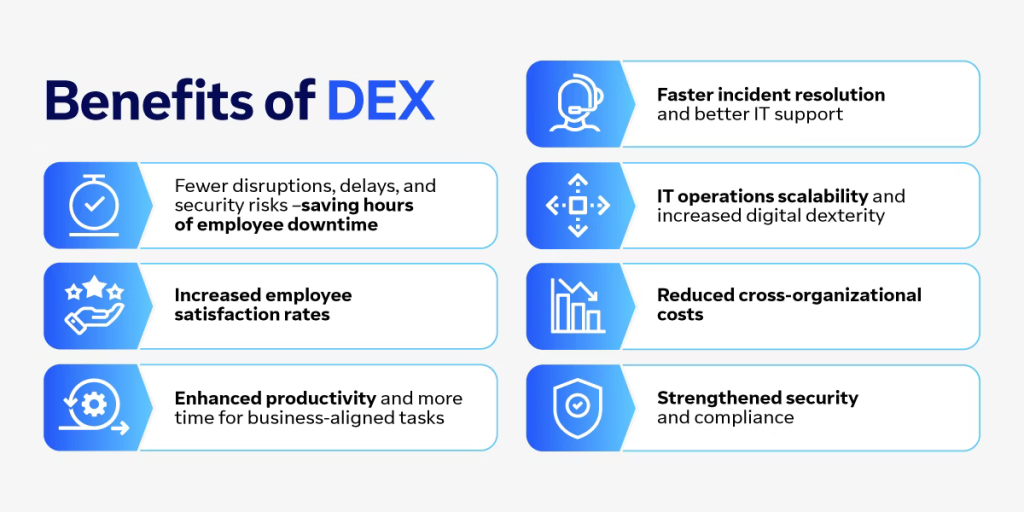
In one real-world case from TeamViewer’s reporting, device uptime rose to 98%, mean time to resolution (MTTR) dropped, and overall digital friction fell.
These gains map to cost savings: fewer helpdesk tickets, less wasted time, lower churn, and sharper productivity per employee.
From Investment to Payback
Real figures turn heads in the C-suite. Implementing DEX tools and processes is not just a cost center—it pays itself back through operational savings and output gains. Boards love investments where you can demonstrate metrics like “hours saved,” “incident reduction,” “staff retention uplift,” and “cost per ticket down.”
DEX in SMBs: A Practical How-to-Start Guide
So, how do you get started on DEX?
1. Audit your tech experience today
Survey your people: what tools frustrate them? How much time is lost on simple IT snags?
2. Pick a DEX or DEX-adjacent platform
Options integrate monitoring, automation, and analytics—ideally with endpoint visibility, issue detection, and self-healing workflows.
3. Prioritise quick wins
Focus on devices used by many (laptops, software suites) and workflows critical to revenue or operations.
4. Measure and iterate
Track baseline metrics (ticket volume, resolution times, satisfaction). Compare post-DEX results and refine.
5. Culture + training
Encourage feedback and transparency: make it safe for staff to report technical issues, and empower IT to take action.
DEX is Not a Fancy Trend. It’s Your Competitive Advantage
For Australian small and medium businesses, DEX isn’t a luxury—it’s a strategic lever. When employees can rely on their tools rather than wrestle with them, productivity, retention, and morale—plus your bottom line—all improve.
In the next 6–18 months, digital-workplace leaders will increasingly take DEX for granted. SMBs that adopt it early aren’t chasing fancy trends—they’re securing agility, cost control, and competitive edge.
Make your business one of them.
About the Author
This blog was authored by TeamViewer.


